DUMB
Robert Rush, Paul Housely, Rebecca Ackroyd, Thom Trojanowski, Justin Fitzpatrick, Archie Franks, Aly Helyer, Willem Weismann


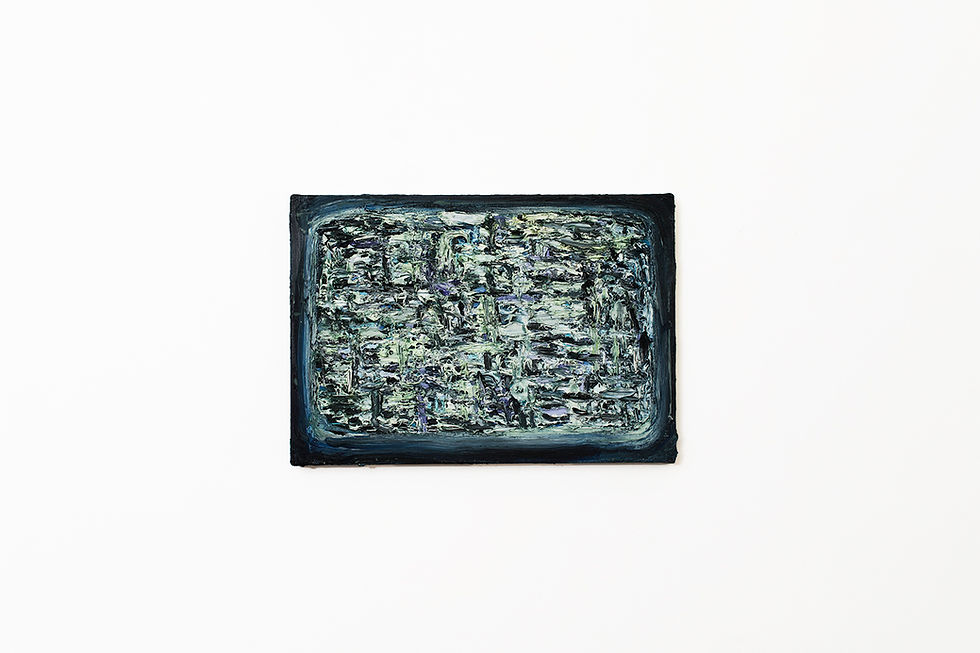
DUMB
Rebecca Ackroyd, Justin Fitzpatrick, Archie Franks, Aly Helyer, Thom Trojanowski, Paul Housley, Robert Rush, Willem Weismann
Mercer Chance, London
The title of this exhibition comes from a remark by Philip Guston, who described paint as "a dumb material." It is an unexpectedly generous phrase. Paint is mute matter: coloured paste spread across cloth or wood, possessing no language, no intelligence, no innate meaning. Yet from this stubbornly inert substance artists continue to construct images capable of carrying humour, violence, tenderness and doubt. Guston's observation acknowledges painting's peculiar condition: it remains irreducibly material, even while inviting endless interpretation.
The artists in DUMB share an affinity with this condition. Their works are populated by awkward figures, holes in the ground, fragments of bodies, cartoon logic, malformed objects and improbable encounters. They embrace subjects that are vulnerable, comic or ungainly without reducing them to jokes. Rather than disguising the awkwardness of painting, they allow it to become part of the work's emotional and aesthetic force.
Painting embodies something of this condition. It is a silent medium whose physical reality remains faintly absurd. Anyone who has painted knows the peculiar sensation of moving coloured mud around a surface in the hope that it might become something more. As Paul Housley has observed, painting itself is a fundamentally "dumb" activity. One history of painting can be understood as a long effort to conceal this material awkwardness beneath illusion, virtuosity or intellectual refinement. Another history runs alongside it: artists repeatedly returning to banality, directness and clumsiness as a way of renewing the medium.
Over the past century and a half, painting and sculpture have repeatedly embraced forms of apparent stupidity, awkwardness and anti-sophistication as an escape from exhausted conventions. Dumbness is therefore both subject and method. It resists polish and hierarchy, allowing the fantastic and the banal to coexist without apology. Guston's own return from abstraction to crude, cartoon-like figuration in the late 1960s and 1970s exemplified this shift. His paintings of shoes, clocks, cigarettes, bricks and hooded figures rejected prevailing notions of refinement in favour of images that were stubbornly ordinary, comic and unsettling. Critics such as Hilton Kramer dismissed the work as wilfully regressive, but Guston had recognised that painting's intelligence could emerge precisely through its willingness to appear dumb.
Questions of value inevitably circulate around this aesthetic. Why paint these things? Why paint them like this? Yet painters have long understood that comedy and tragedy intensify one another when held together in paint. The Japanese underground cartoonist King Terry coined the term heta-uma—"bad but good"—to describe works whose apparent lack of skill generated a distinct aesthetic vitality, distinguishing them from uma-heta: technically accomplished works that nevertheless lacked feeling. The distinction is less about competence than conviction.
Across the works in DUMB, awkwardness becomes a form of empathy. Rebecca Ackroyd, Justin Fitzpatrick, Archie Franks, Aly Helyer, Thom Trojanowski, Paul Housley, Robert Rush and Willem Weismann each approach this territory differently, yet all allow images to remain materially present, unresolved and vulnerable. Their paintings and sculptures refuse the seamless polish that so often stands in for seriousness. Instead they linger in moments of bathos, humour and uncertainty, trusting that awkwardness can carry its own emotional weight.
To paint the world in a consciously "dumb" way is not to mock it, but to refuse easy distinctions between intelligence and foolishness, beauty and banality, subject and material. Paint remains paint even as it becomes a face, a pipe, a traffic cone, a hole in the ground or a hand reaching out of the earth. In that continuity between medium and image lies a modest but profound form of empathy: the recognition that awkwardness, vulnerability and absurdity are not flaws to be overcome, but shared conditions of being.